About EPSCoR

EPSCoR was established by the National Science Foundation in 1979, with a mission of stretngthening research and education in science and engineering throught the U.S. In 1991-92 the U.S. Congress asked other federal agencies supporting academic research to form EPSCoR programs similar to that of NSF.

To date, seven federal agencies have EPSCoR programs: the National Science Foundation (NSF), the National Institutes of Health (NIH), Dept. of Defense (DoD), U.S. Dept. of Agriculture (USDA), National Aeronautics and Space Administration (NASA), Dept. of Energy (DOE), and the Environmental Protection Agency (EPA).

The National Science Foundation designates states as qualifying for EPSCoR funds. That designation then carries eligibility to apply for any federal agency EPSCoR funds. Each federal agency administers its EPSCoR program as it best contributes to their mission.

NASA's EPSCoR funds are administered by the NASA Space Grant infrastructure.
NASA EPSCoR directory...


  NASA logo
Univ. of NH logo

NH Great Bay
EPSCoR Research Award will use Earth Observations to study infectious disease ecology in NH.

vacuum chamber
EPSCoR Research & Infrastructure Development Cooperative Agreeement expands NH facilities for testing small satellite components.

New Hampshire NASA EPSCoR

NH NASA EPSCoR currently has two funded projects: a Research & Infrastructure Development (RID) Cooperative Agreement, and a NH NASA EPSCoR Research Award.

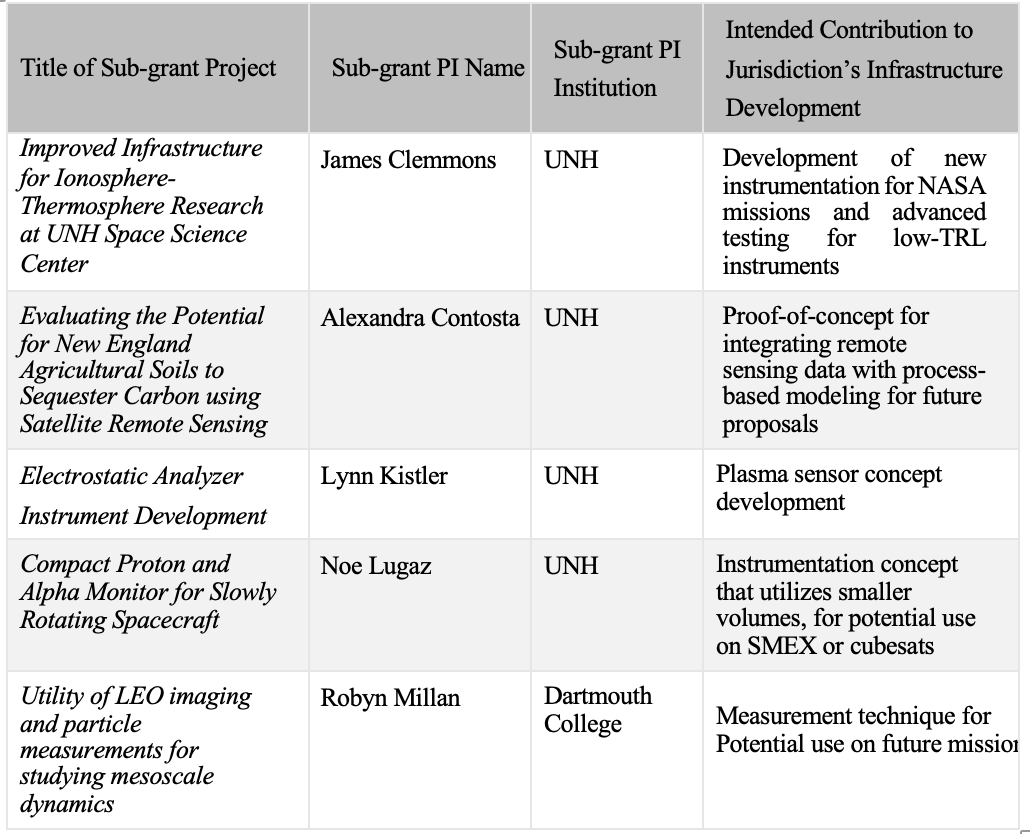
The Research & Infrastructure Development (RID) Cooperative Agreement supports collaboration among space science and engineering investigators at the University of New Hampshire, Dartmouth College, and BAE Systems of North America. Their focus: positioning NH for future opportunities in deploying small satellites for research and other applications.

Building on the existing experience in providing hardware for studies of Sun-Earth environment, the grant proposes to:
• Provide opportunities for exploring the use of new facilities provided through NH NSF EPSCoR project;
• Partner scientists and engineers at UNH, Dartmouth, and BAE Systems in development and testing of small satellite technologies;
• Prepare young investigators at UNH and Dartmouth for future missions and to become the next generation of investigators.

Space science and small satellite themes are clearly related to NASA's mission and priorities, as well as those of other federal agencies. A number of commercial space companies are also pursuing small platform technology. BAE Systems is engaged in a company-wide effort to explore small satellite sensors and low-power sensors for federal agency customers. A major barrier to pursuing these goals, identified by the NH EPSCoR Committee, is lack of high-end facilities for testing satellite components in space-similar environments. This grant works toward meeting that need.

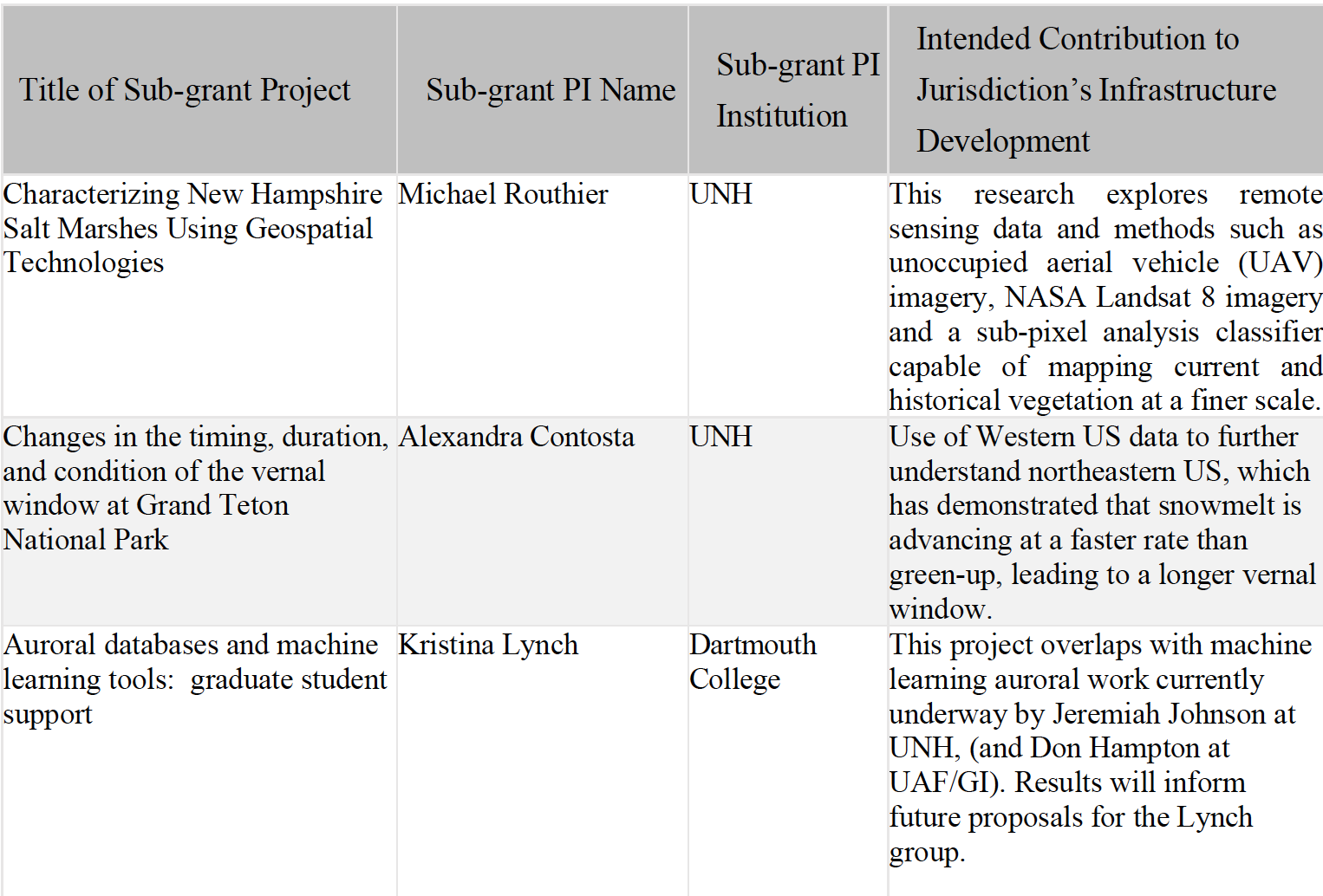
The NH NASA EPSCoR Research Award integrates Earth Observations with Infectious Disease Ecology and Public Health in New Hampshire. Environmental change its effect human health is a great challenge in the 21st century. Changes in climate and land use are likely to alter human-environmental systems and the pathogen-vector-host relationships of infectious diseases.

This NH NASA EPSCoR project combines satellite imagery, field samples, human health data, and mathematical models in a study of the ecology and risk factors of Lyme disease in NH and northern USA. It partners NH state agencies, private industry, and an interdisciplinary university research team (geospatial technology, disease ecology, public health, and mathematics).

The end result is improved geospatial datasets that can increase our understanding of ecology and the risk factors of infectious diseases. In the future, it could help in identifying geographical "hot spots" and in issuing early warnings.

A long-term goal is to establish a UNH center of excellence in the application of geospatial technology for disease ecology and public health. It could raise the competitiveness of NH research programs, add to NH economic development and job opportunities in geospatial technology, science, mathematics, and health.